Rideshare insurance by app status: the period-1 gap and what an endorsement costs
If you drive for a ride-hailing or delivery app, your car is covered by different insurance depending on what the app is doing at that moment. The handoffs between your personal policy and the platform's coverage leave gaps, and the biggest one opens exactly when most drivers spend most of their time: app on, waiting for a request.
This guide explains the coverage periods, works through a crash in the gap with and without a rideshare endorsement, compares the cost of the endorsement with one uncovered claim, and covers delivery driving, which has its own complications.

The three periods
Ride-hailing coverage is usually described in periods based on app status:
| Period | App status | Typical coverage |
|---|---|---|
| 0 | App off | Your personal auto policy |
| 1 | App on, waiting for a request | Platform's limited liability coverage, often around state minimums; usually nothing for your own car |
| 2 | Request accepted, driving to pickup | Platform's higher liability coverage, often $1 million; contingent collision and comprehensive if you carry them personally |
| 3 | Passenger in the car | Same as period 2 |
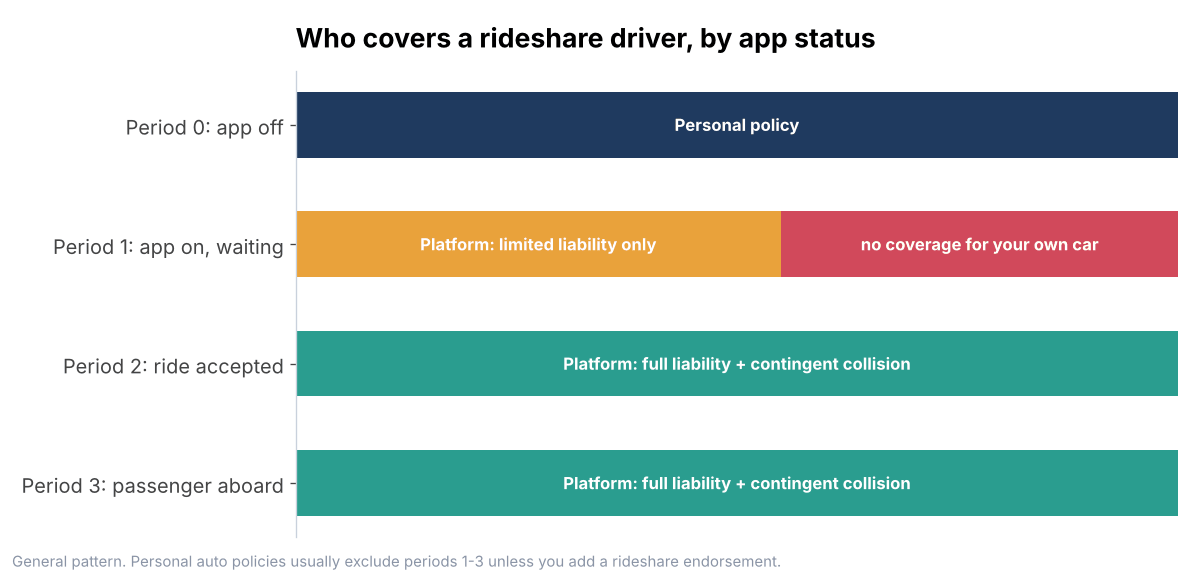
Here's the catch: most personal auto policies exclude driving for hire. Once the app is on, your personal policy may not cover anything, even in period 1, when the platform's coverage is at its thinnest.
A crash in period 1
A driver has the app on and is waiting for a request. They rear-end another car at a light. Their own car has $6,000 of damage, and the other car has $4,500.
- The other car's damage usually falls under the platform's period-1 liability coverage.
- The driver's own car is the problem. Without a rideshare endorsement, the personal policy may deny the claim because the app was on, and the platform's period-1 coverage usually doesn't include damage to the driver's own car.
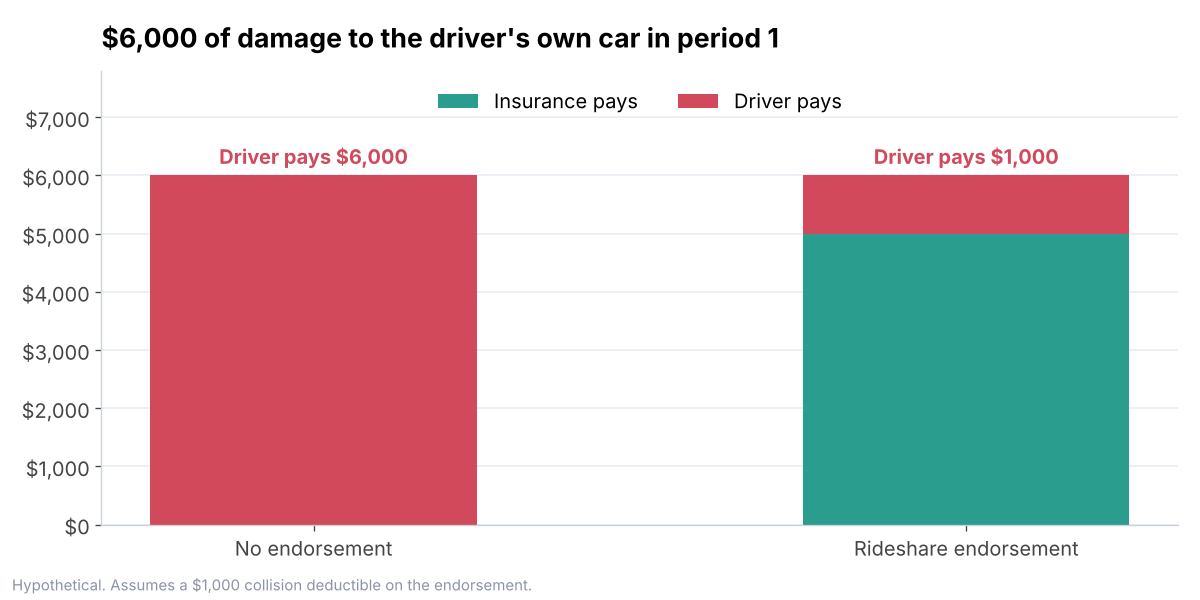
A rideshare endorsement on the personal policy extends coverage into period 1, and often fills gaps in periods 2 and 3, such as the platform's high deductible. Some insurers offer a hybrid policy instead. Not every insurer offers either.
For a closer look at how the periods work for ride-hailing and delivery apps, and how to check what your own policy says, see this guide to rideshare and delivery insurance gaps.
Cost vs. one claim
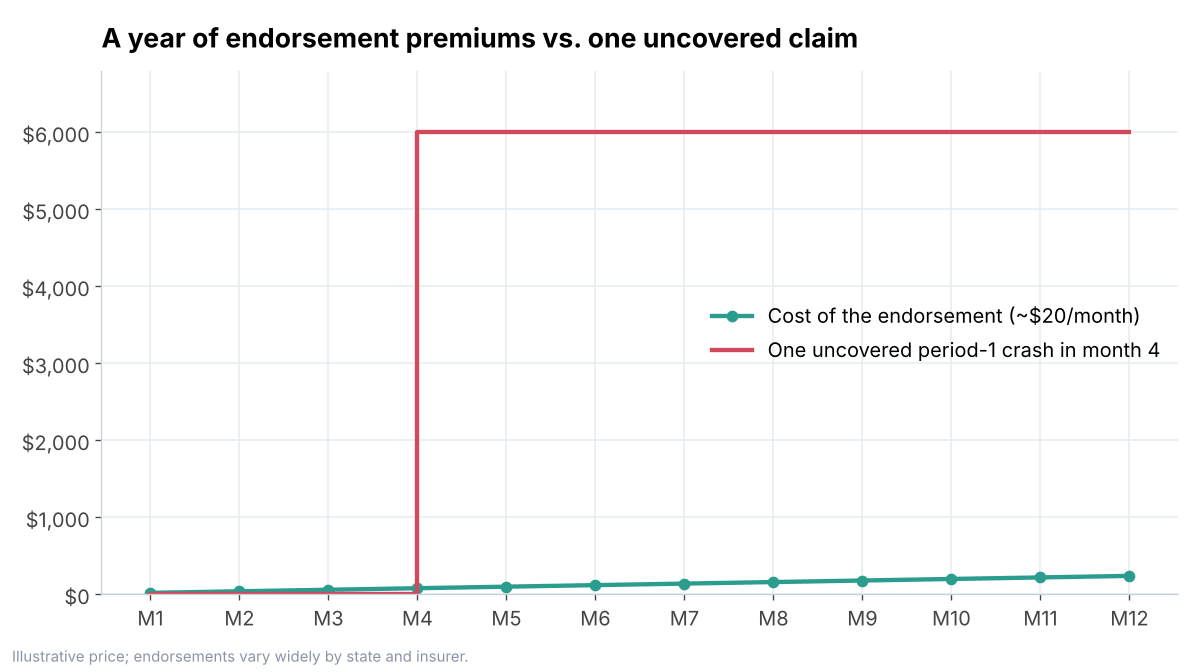
Endorsement prices vary widely, but they're often modest compared with the uncovered exposure. The bigger risk is often not the repair bill but the policy itself. An insurer that finds undisclosed rideshare driving after a claim may cancel or not renew the policy, which can make the next policy more expensive.
Delivery driving
Food and package delivery apps work differently. Some provide coverage only while you're on an active delivery, and some provide only excess liability coverage that pays after your personal policy. If your personal policy excludes delivery, there may be nothing underneath it.
Things to check with your insurer:
- Does the policy exclude delivery for a fee, and is a delivery endorsement available?
- Does it treat delivery the same as ride-hailing?
- Does it cover your own car while you're making deliveries?
A period-2 crash, for comparison
Once a ride is accepted, the platform's coverage usually becomes much broader. Suppose a driver on the way to a pickup causes a crash that injures another driver and damages both cars:
| Item | Amount | Usually paid by |
|---|---|---|
| Other driver's injuries | $85,000 | Platform liability coverage |
| Other car's damage | $9,000 | Platform liability coverage |
| Driver's own car | $7,500 | Platform contingent collision, after its deductible, if the driver carries collision personally |
| Platform's collision deductible | Often $1,000 to $2,500 | Driver, unless an endorsement covers it |
The liability side is usually handled well in periods 2 and 3. The driver's own exposure is the platform's physical damage deductible, and the requirement to carry collision on the personal policy for the contingent coverage to apply. Some rideshare endorsements cover that deductible too.
Keeping the record clean
A rideshare driver drives many more miles than the average driver, which means more chances for a crash and for a surcharge. A few habits help:
- Don't accept requests while driving. Pull over first.
- Use a phone mount and keep navigation hands-free.
- Take a break after long shifts. Fatigue is a real factor in late-night driving.
- Install a dash camera. Video often settles who was at fault, which protects both your claims history and your premium.
What to do
- Read your personal policy's exclusions for "public or livery conveyance" and "delivery." These are the clauses that usually remove coverage.
- Call your insurer and ask whether it offers a rideshare or delivery endorsement. Get the answer in writing.
- Check the platform's current coverage terms, including limits, deductibles, and whether contingent collision requires you to carry collision on your own policy.
- Keep collision and comprehensive on your own policy if you want the platform's contingent physical damage coverage in periods 2 and 3. It often only applies if you carry them yourself.
- Keep records. Screenshots of the app status at the time of a crash help establish which coverage applies.
- Consider uninsured motorist coverage. Driving more miles in traffic means more exposure to uninsured drivers.
Quick answers
Does my personal policy cover me if I only drive part-time? Not necessarily. Many exclusions apply whenever the app is on, regardless of how many hours you drive.
Is the platform's insurance enough on its own? In periods 2 and 3 its liability coverage is usually substantial. Period 1 is the weak spot, along with high deductibles on physical damage.
Will an endorsement raise my premium a lot? Usually much less than a commercial policy. Prices vary by state and insurer.
Sources and further reading
- National Association of Insurance Commissioners: Transportation network company insurance
- Insurance Information Institute: Rideshare insurance
- Your state insurance department's guide to rideshare coverage
Hypothetical figures and illustrative prices. General information only, not insurance advice. Platform coverage and policy terms change and vary by state.